

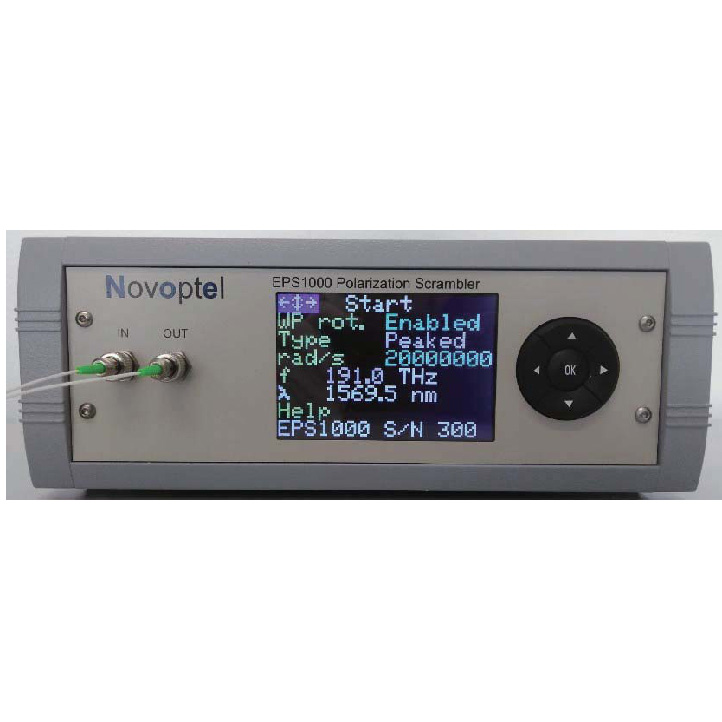

EPS1000 Polarization Scrambler/Transformer
EPS1000 Polarization Scrambler/Transformer
x Ultrafast endless optical polarization scrambling at up to 20 Mrad/s (or 80 Mrad/s with less waveplates) x 10 ns
x Ultrafast endless optical polarization scrambling at up to 20 Mrad/s (or 80 Mrad/s with less waveplates) x 10 ns
产品详情
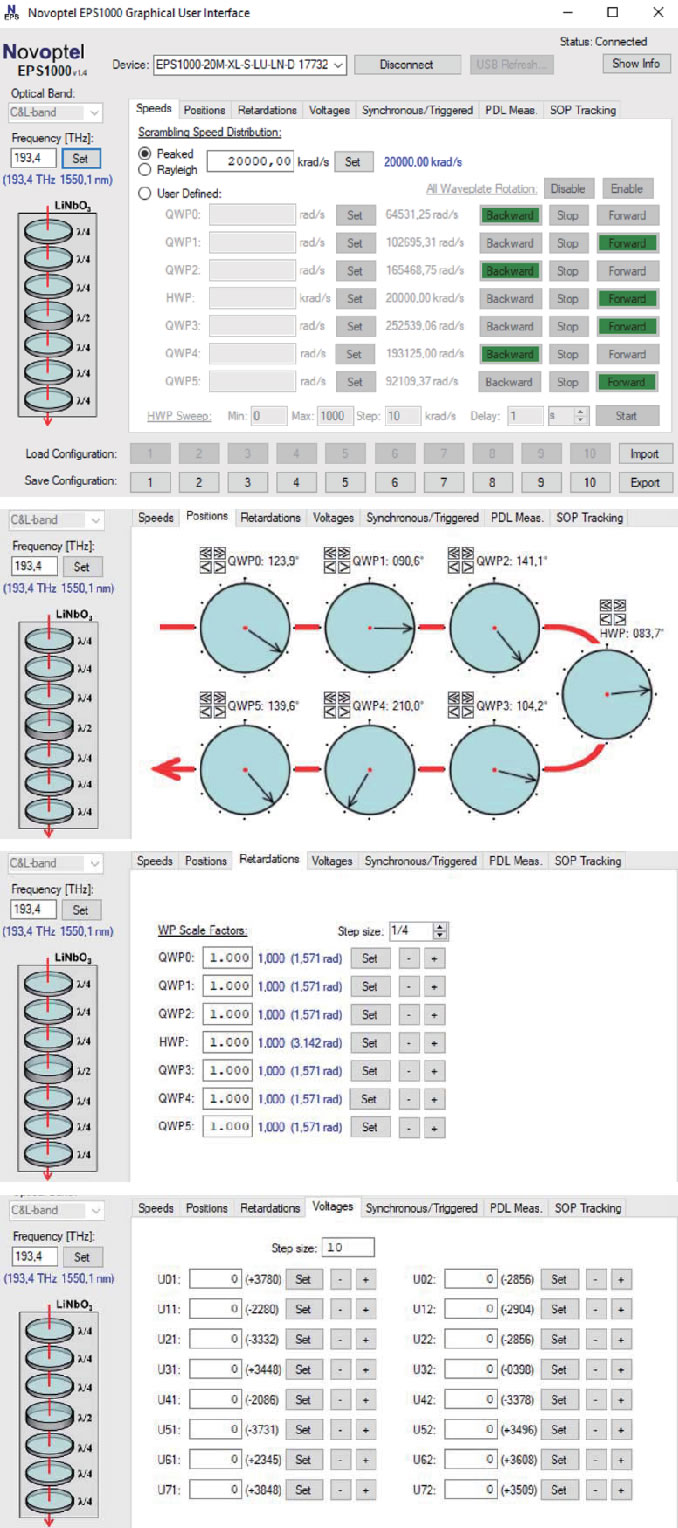
Left: Frequently used operation modes of USB- or LAN-operated graphical user interface. Other operation modes are:
Pseudorandom state generation
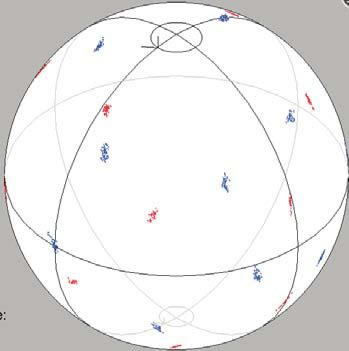
Above: 20 vertices of dodecahedron, measured at the ends of 640 ns symbols.
Below: Transients visualized, 1 ms symbols
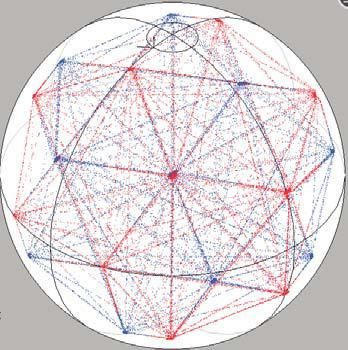
Emulation of lightning strikes in fiber with EPS1000-20M
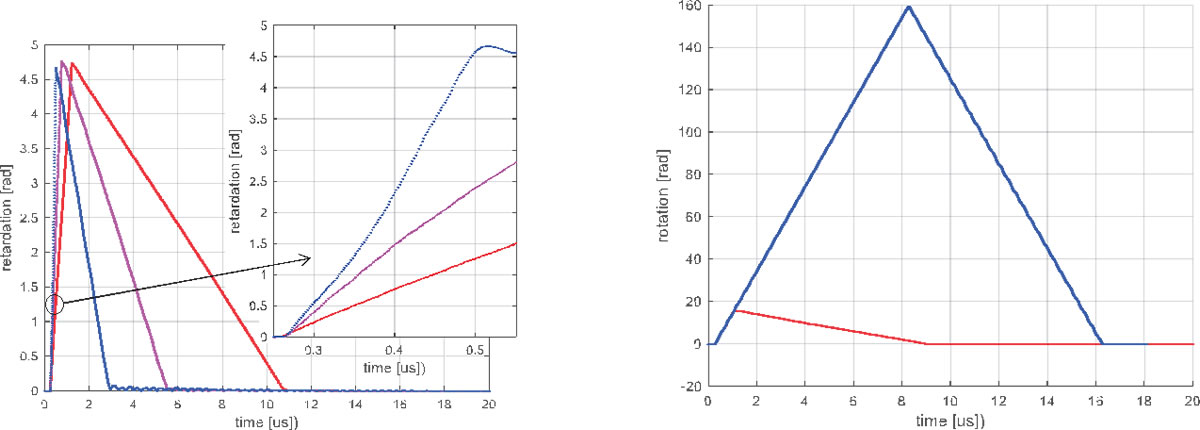
Circular retardation vs. time with 2 ns temporal resolution for scrambling 3 different speed profiles, all having the same peak retardation of 4.8 rad.
Polarization rotation for 800 ns / 8000 ns @ 20 Mrad/s, and return in 8000 ns.
EPS1000 Polarization Scrambler/Transformer
x Ultrafast endless optical polarization scrambling at up to 20 Mrad/s (or 80 Mrad/s with less waveplates) x 10 ns clock cycles (= updating intervals) assure continuous, quasi steady polarization changes even at
high scrambling speeds (e.g., in 0.01 rad steps at 1 Mrad/s) and minimize deviations from desired smooth time-dependence of trajectory, for meaningful assessment of polarization/PMD tracking/trackers.
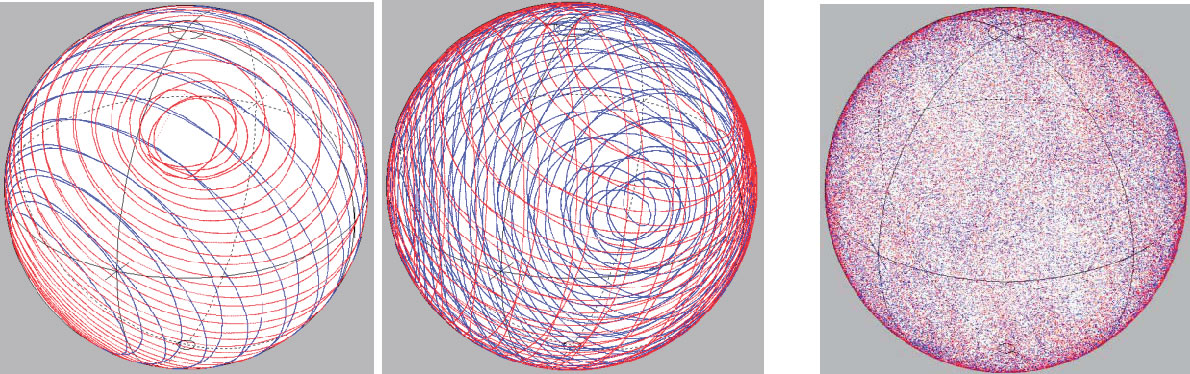
Slow HWP operation Fast HWP operation
Exemplary output trajectories on Poincaré sphere
60-V step at HWP settles completely within 50 ns (20 ns/div). Small-signal response is a lot faster.
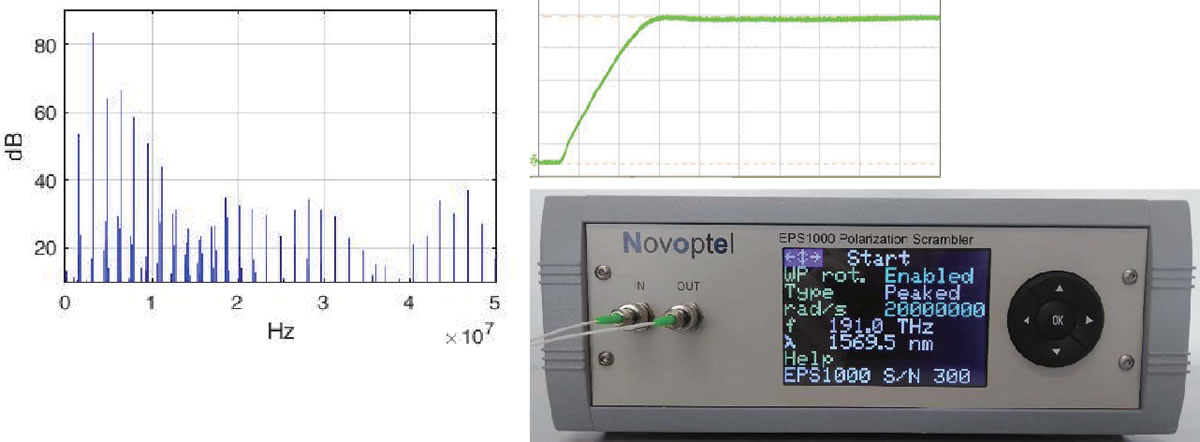
Electrical scrambling spectrum. Only HWP scrambles at 20 Mrad/s. Recorded with PM1000 polarimeter
x Ultrafast endless optical polarization scrambling at up to 20 Mrad/s (or 80 Mrad/s with less waveplates) x 10 ns clock cycles (= updating intervals) assure continuous, quasi steady polarization changes even at
high scrambling speeds (e.g., in 0.01 rad steps at 1 Mrad/s) and minimize deviations from desired smooth time-dependence of trajectory, for meaningful assessment of polarization/PMD tracking/trackers.
- 3 electrooptic quarterwave plates (QWPs) + 1 halfwave plate (HWP) + 3 QWPs with adjustable rotation speeds (QWP: −2000000.00 ... +2000000.00 rad/s; HWP: −20000.00 ... +20000.00 krad/s)
- NEW Optional O-E-S-C-L-U band operation d182...241 THz / 1241...t1647 nm
- Insertion loss ~1.8...2.5 dB. Power consumption ~12 W (+5 V power supply 100-240 V included)
- Differential group delay (DGD) sections consisting of polarization-maintaining fibers (PMF) available for highly realistic PMD emulation, using several EPS1000 and DGD sections.
- Available as a desktop unit, module or intellectual property core
- Interfaces for computer (USB, LAN) or controller (SPI, UART, digital hardware lines)
- Standalone operation of desktop unit via control buttons. Several units can be controlled simultaneously by graphical user interface (GUI; see next page), Matlab™, Labview™ or similar. Speeds of rotating and positions of stopped waveplates and electrode voltages can be set, saved and loaded.
- Serial Peripheral Interface (SPI) permits realtime operation; e.g., direct setting of waveplate voltages.
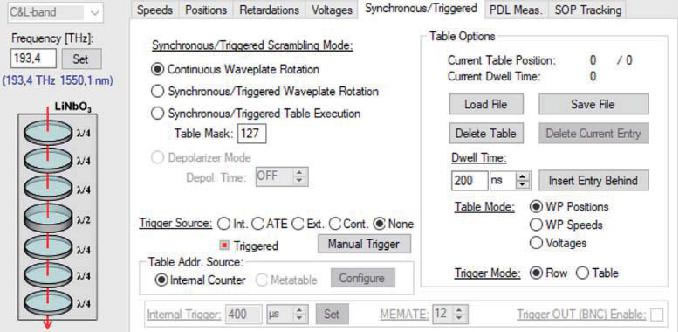
- In synchronous scrambling mode, user-generated tables with sets of waveplate positions or speeds can be loaded. Following an external trigger event (3.3 V LVCMOS signal applied at BNC connector, or SPI command) the sets are executed sequentially at specified instants (granularity: 40 ns; minimum delay until next execution instant: 200 ns). For recirculating loop experiments and emulation of lightning strikes.
- In triggered scrambling mode, the sets are executed cyclically one by one upon external trigger events or USB commands (minimum delay until next execution instant: 200 ns). Application examples: polarization-dependent loss (PDL) and Mueller/Jones matrix measurements.
- Optional photodetectors enable accurate PDL and loss measurements and polarization tracking.
- Depolarization in 960...360 ns interval, based on 50 Mrad/s version with 3 rotating waveplates
- EPX1000 = cost-saving desktop unit with combined functionalities of EPS1000 and 40...100 krad/s polarization controller/demultiplexer EPC1000
- PMS1000 = combination of EPS1000 with ultrafast (100 MHz) polarimeter PM1000
Slow HWP operation Fast HWP operation
Exemplary output trajectories on Poincaré sphere
60-V step at HWP settles completely within 50 ns (20 ns/div). Small-signal response is a lot faster.
Electrical scrambling spectrum. Only HWP scrambles at 20 Mrad/s. Recorded with PM1000 polarimeter
Left: Frequently used operation modes of USB- or LAN-operated graphical user interface. Other operation modes are:
- Device Testing (optional): Intensity recording for PDL and loss measurement
- SOP Tracking (optional): Tracks SOP as defined by PM1000, also during optical frequency sweep and according to table
Pseudorandom state generation
Above: 20 vertices of dodecahedron, measured at the ends of 640 ns symbols.
Below: Transients visualized, 1 ms symbols
Customer feedback
"We have used the EPS1000 endless polarization scrambler in our record-breaking coherent transmission experiments (see our site www.optcom.polito.it) and it has performed flawlessly. We have particularly appreciated its very low insertion loss and its flexibility. Thanks to the EPS1000 endless polarization scrambler our recirculating-loop experimental results have become stable, repeatable and reliable."
Prof. Dr. Pierluigi Poggiolini, Politecnico di Torino, Italy
Emulation of lightning strikes in fiber with EPS1000-20M
Circular retardation vs. time with 2 ns temporal resolution for scrambling 3 different speed profiles, all having the same peak retardation of 4.8 rad.
Polarization rotation for 800 ns / 8000 ns @ 20 Mrad/s, and return in 8000 ns.
The polarization scrambler EPS1000 has been used to demonstrate lightning protection https://www.infinera.com/ice5-innovation/ of coherent optical data transmission at the OFC2018 exhibition.
Exemplary polarization speed distributions obtained with EPS1000
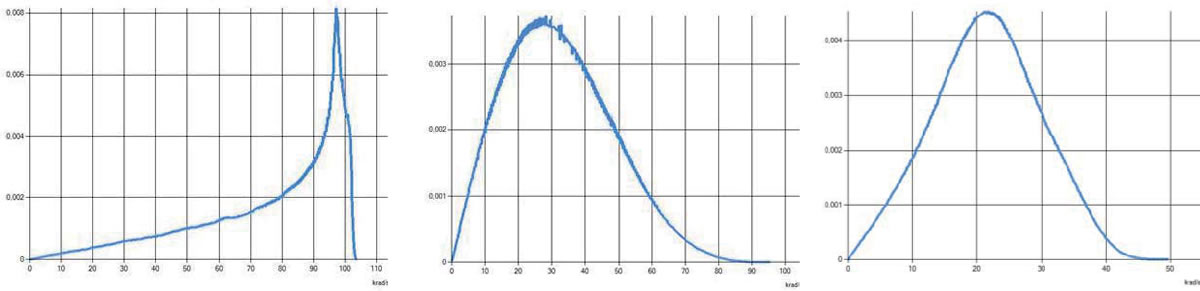
Peaked (for fastest assessment Quasi-Rayleigh Triangular
of coherent RX)
Scalable software examples (Python, Matlab) available for speed setting. Many other choices
EPS1000-50M Depolarizer
Mean and maximum degree-of-polarization
(DOP) obtained with 1000 random input
polarizations
Exemplary polarization speed distributions obtained with EPS1000
Peaked (for fastest assessment Quasi-Rayleigh Triangular
of coherent RX)
Scalable software examples (Python, Matlab) available for speed setting. Many other choices
EPS1000-50M Depolarizer
- 80 Mrad/s version with 2 QWPs (8 Mrad/s) + 1 HWP (40 Mrad/s)
- Sets of periodic electrode voltages with integer relative driving frequencies, for instance [2, 3, 2]
- Depolarization in 960...360 ns interval
- Independent of input polarization
Mean and maximum degree-of-polarization
(DOP) obtained with 1000 random input
polarizations
 Products
-
服务热线
400-018-5117 -
微信
